
Rich Communication Services (RCS):
How It Boosts Engagement
For organizations across for-profit and nonprofit spheres, text messaging has become a crucial part of their engagement efforts, helping them meet audiences where they are: on their phones. The past few years have seen rapid developments in application-to-person (A2P) texting technology, moving beyond short message service (SMS) and multimedia messaging service (MMS) to the latest in text engagement, rich communication services (RCS).
RCS enables organizations to send branded, interactive messages directly to stakeholders’ inboxes, enhancing the messaging experience without requiring third-party app downloads. The market for rich communication services is growing, estimated at $3 billion in 2025 and projected to reach $13.1 billion by 2035.
In this guide, we’ll break down what RCS messaging is, the benefits inspiring organizations to pursue this messaging technology, and what features your RCS service provider should offer to help you maximize results. We’ll cover:
- FAQs about Rich Communication Services
- How RCS Messaging Differs From Other Messaging Methods
- Benefits of Rich Communication Services
- Key Features of RCS Messaging Platforms
- Choosing the Right Rich Communication Services Provider
FAQs about Rich Communication Services
What is RCS messaging?
Rich Communication Services (RCS) is a messaging method that enables senders to add brand verification and app-like interactivity to their text messages. Rich elements of RCS messaging can include:
- Carousels
- Embedded forms
- Quick-reply chips
- Custom CTA buttons
Who uses RCS messaging?
Businesses, higher education institutions, and nonprofits use RCS to send engaging, trusted text messages that drive higher conversions. For example, universities might use it to accelerate their student enrollment, while nonprofits use it to boost donor retention.
How do organizations start with rich communication services?
Start by partnering with a messaging platform built for your organization’s CRM (like Salesforce). This enables you to launch interactive campaigns using existing data. By creating, sending, and tracking RCS messages from your CRM, you can:
- Send messages attached to your official company name, with a logo and a checkmark to verify your identity
- Share high-resolution images, videos, audio files, and GIFs
- Monitor real-time delivery confirmations and read receipts
How RCS Messaging Differs From Other Messaging Types
Unlike standard plain-text SMS or basic MMS media, RCS delivers high-resolution assets, read receipts, and verified sender profiles. It outperforms third-party over-the-top (OTT) applications by eliminating the need to download a separate app.
RCS vs SMS
SMS messages are the most basic type of text messaging. In a marketing and engagement context, these messages allow you to use plain text to:
- Promote your organization
- Confirm a transaction
- Spark a conversation
- Send a reminder
- Collect feedback
RCS messages serve the same function with the added benefit of interactive, engaging content with a more branded experience. With RCS, you can send high-quality multimedia messages with app-like interactive components. For example, consider the difference between the two messages below:
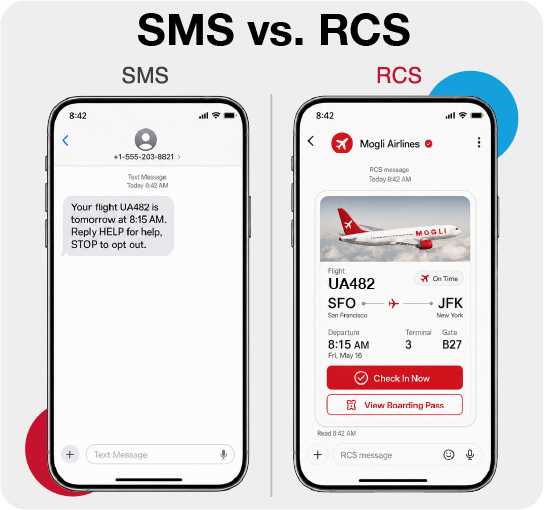
The SMS message is a helpful reminder of when the recipient’s flight is scheduled, but it doesn’t capture readers’ attention, nor does it direct them to the logical next step. The RCS message, on the other hand, allows the recipient to see the departure time for their flight, view their boarding pass, and guides them toward the check-in button. Readers will also appreciate that the RCS message provides visual branding to let them know the message is legitimate.
RCS messages have much larger character limits than SMS and display verified sender profiles instead of anonymous phone numbers. This way, you’ll ensure stakeholders receive all of the information they need and build trust with them.
RCS vs MMS
MMS marketing enables your organization to send multimedia messages that include elements like:
- Photos
- Videos
- Audio files
- GIFs
MMS marketing builds on SMS marketing, but it still doesn’t match the media quality of RCS messaging. Rich communication services enable high-resolution image and video sharing in-thread without heavy compression. Additionally, unlike MMS, RCS offers granular read receipts and engagement tracking.
RCS vs OTT
Over-the-top (OTT) messaging sends text messages via third-party apps that use the internet rather than cellular mobile networks. This includes platforms like WhatsApp and WeChat. This method enables you to send high-quality rich media without the sizing limits of MMS.
The downside of OTT is that it requires users to download an app if they don’t already use WhatsApp. Rich communication services, on the other hand, send OTT-quality messages without the need for a third-party app. This way, you’ll be able to reach stakeholders where they already are.
Benefits of Rich Communication Services
RCS messaging drives revenue and engagement by replacing static text with interactive, branded conversational experiences. By incorporating this type of messaging into your outreach plans, you can access benefits like:
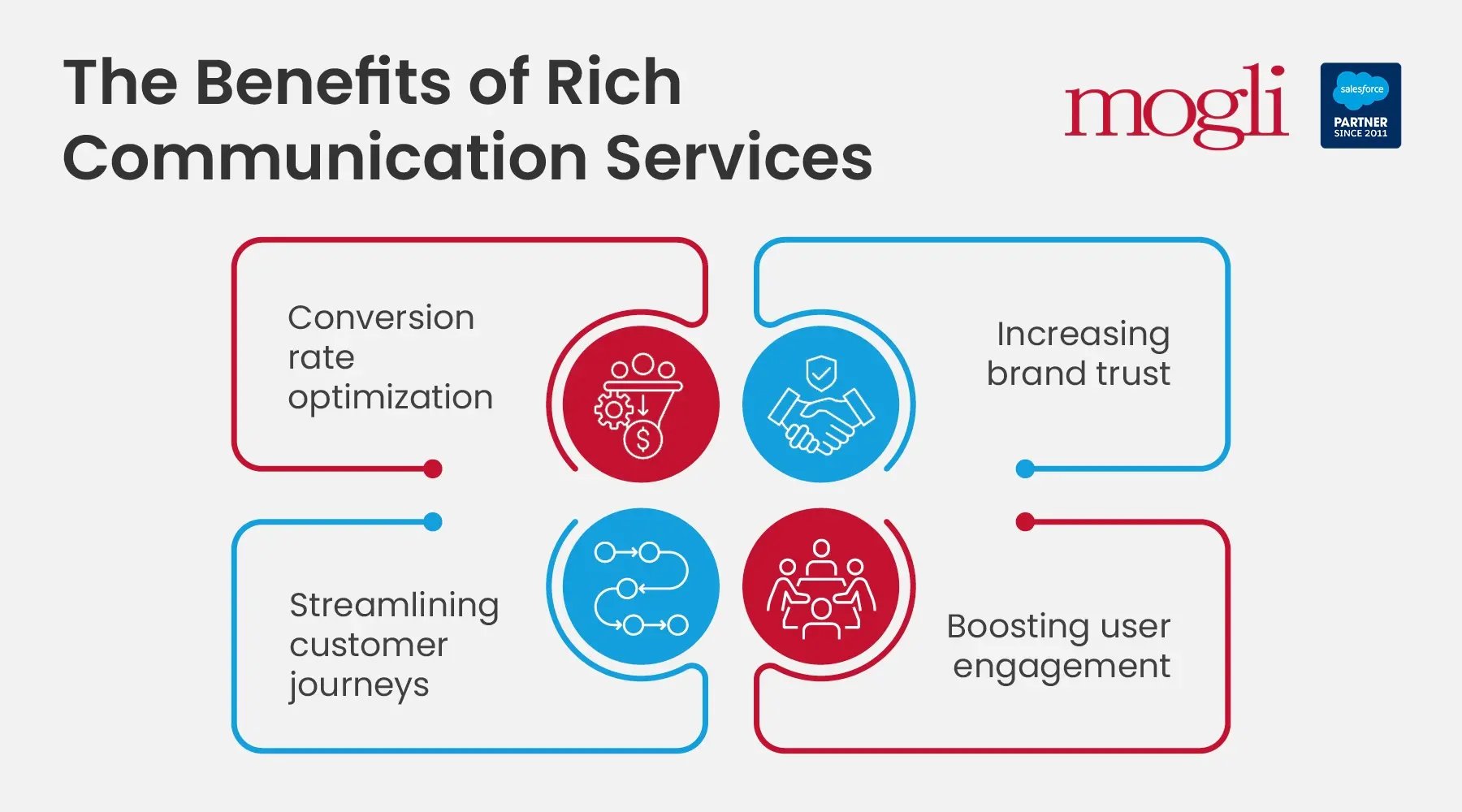
- Conversion rate optimization: Organizations can achieve up to 32% more conversions compared to traditional SMS campaigns by leveraging app-like interactivity.
- Increasing brand trust: Verified sender profiles establish authenticity, ensuring recipients feel secure when interacting with your organization's messaging.
- Boosting user engagement: Interactive content encourages users to engage with your content more actively.
- Streamlining customer journeys: With custom CTA buttons embedded in your message, readers can easily take the next steps.
Key Features of RCS Messaging Platforms
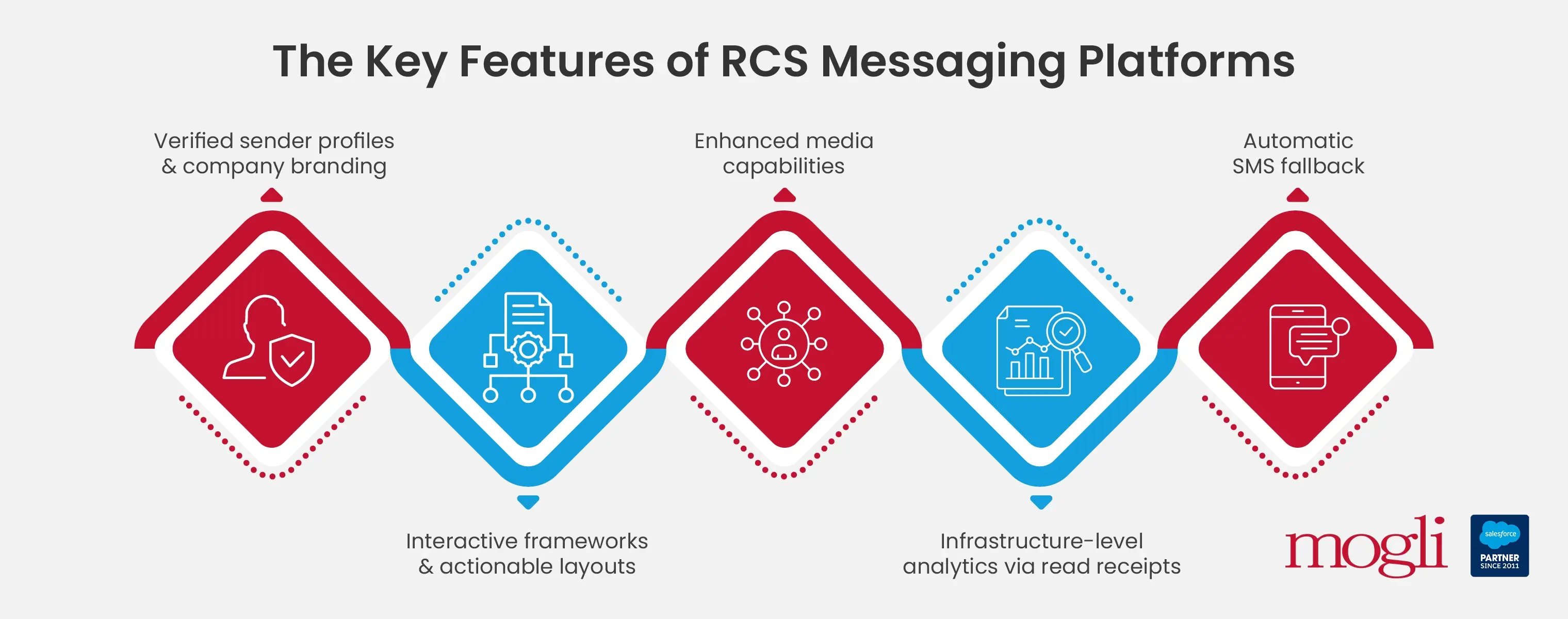
A rich communication services platform enables your organization to easily send dynamic messages to your audience, inspiring deeper engagement with your brand. With the right platform, you can create, send, and track messages directly from your CRM. Below, we’ll outline the core features your organization should look for in an RCS messaging platform.
Verified sender profiles & company branding
Your RCS messaging platform should enable you to send messages attached to your brand name, logo, and verification badge. This way, customers, prospects, or donors can immediately recognize the legitimacy of your communications—rather than dismissing a message from an unknown 10-digit number or shortcode as spam. Ultimately, providing these markers increases customers’ trust in your organization and helps them feel safe engaging with your communications.
Interactive frameworks & actionable layouts
Look for a platform that features suggested replies, CTA buttons, product carousels, and more directly in the messaging conversation. Instead of forcing users to navigate slow-loading mobile browsers, you’ll empower them to interact with your organization by making it easy to pursue the next step in engagement.
Enhanced media capabilities
Marketers often struggle with standard multimedia messages because cellular networks compress the files, leaving images pixelated and videos unwatchable. Rich media sharing supports high-definition photos, videos, and audio files without the heavy compression seen in traditional MMS.
Infrastructure-level analytics via read receipts
Traditional texts leave organizations blind once the message leaves the carrier network, as you never know if a customer read the alert or swiped it away. Engagement tracking provides granular, real-time data on message delivery, read status, and user interactions, if enabled by the message recipient. You can then use this data to course-correct and optimize your messages’ performance.
Your platform should also help you automatically use response data to update existing records and create new ones in your CRM. For example, a higher education institution might use data from its rich communication services messages to update alumni information, enabling them to segment their audience more effectively.
Automatic SMS fallback
If the recipient’s device or network does not support RCS, your RCS platform should automatically revert to a standard SMS message. This way, you’ll be able to message your entire audience base without worrying that those with older devices or unstable connections won’t see your text.
Choosing the Right Rich Communication Services Platform
Mogli unlocks the next generation of mobile communication by supporting RCS messaging directly inside Salesforce. By partnering with Mogli, you’ll access all of the features listed above and gain the ability to:
- Personalize text messages using your existing Salesforce data
- Create form templates & surveys
- Schedule send one-to-one and bulk messages
- Integrate custom trackable links in your texts
- Segment your contact list to tailor your messaging
- Access AI-driven summaries of conversations
- Speed up responses with recommended messages
- Create custom next-step automations
- Enable agentic conversations
Mogli’s platform is built on and built for Salesforce, which makes it easy to create a data-driven text engagement strategy that helps you form meaningful connections with stakeholders.
To learn more about our RCS features, check out the video below:
Increase Engagement with Rich Communication Services
Integrating RCS into your existing Salesforce workflows through Mogli combines your CRM data with rich multimedia capabilities. RCS messaging takes the high open rates of SMS and adds interactive elements that drive higher conversion rates and deeper engagement with your outreach.
Want to learn more about text messaging engagement? Check out these additional resources:
- SMS Automation Basics: How to Send Automated Texts. Save time, increase conversions, and maximize revenue through SMS automation. Learn how to get started.
- AI SMS Marketing: Boosting Engagement Through Conversations. AI has expanded the possibilities for SMS marketing. Discover how AI SMS marketing works in this guide.
- SMS Marketing vs. Email Marketing: Pros and Cons for Brands. Explore the benefits of SMS marketing vs. email marketing to create an effective outreach strategy.